
291: Your Best Meeting Ever: Designing Collaboration That Actually Works with Rebecca Hinds
Play the episode
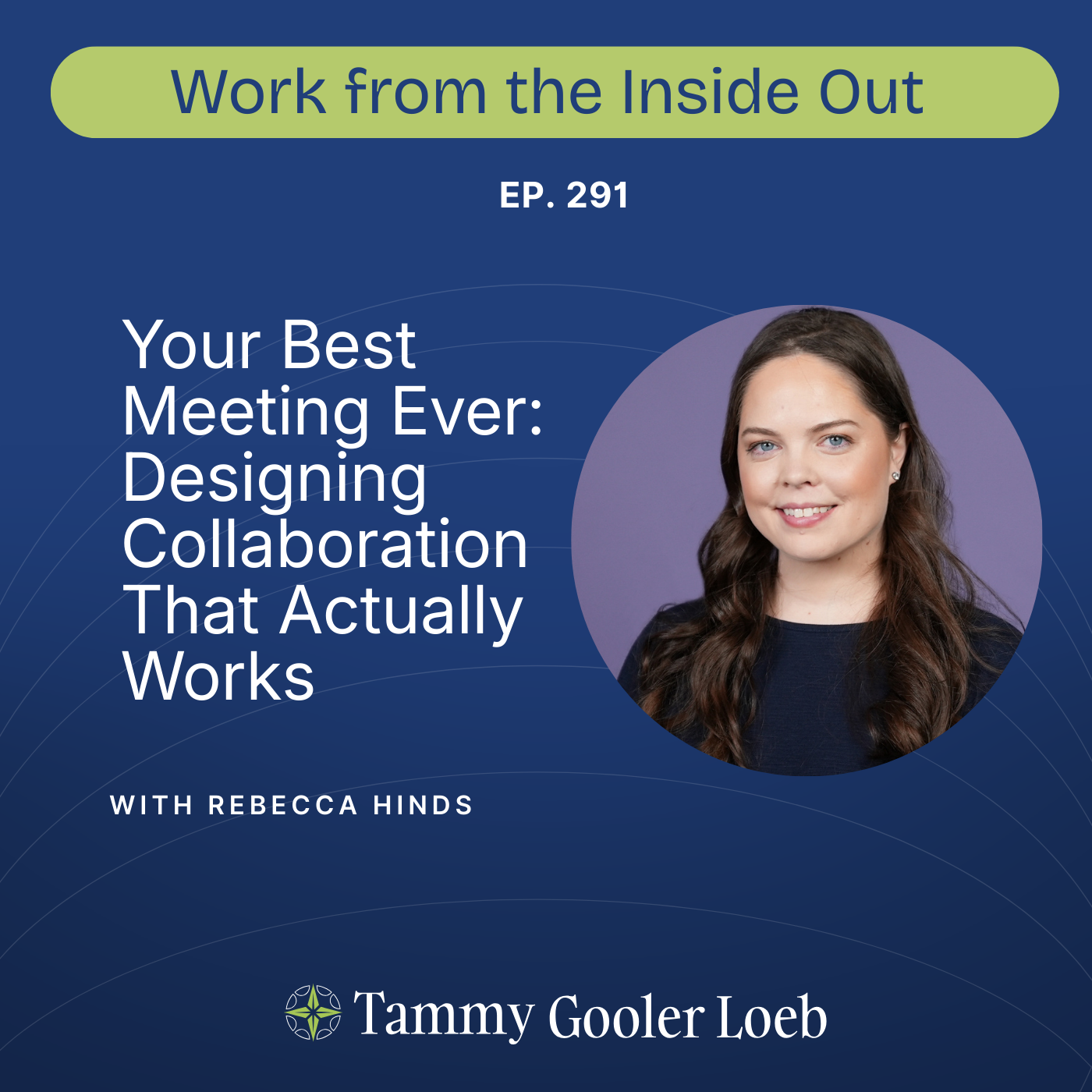
291: Your Best Meeting Ever: Designing Collaboration That Actually Works with Rebecca Hinds
“Meetings.” Few words trigger such an immediate reaction in the workplace. For many, they represent inefficiency, wasted time, or a box to check. But what if meetings could instead become one of the most powerful tools for collaboration, innovation, and career advancement?
In my conversation with Rebecca Hinds, author of Your Best Meeting Ever, we began at the beginning with her years as a competitive swimmer in Canada and later at Stanford. Even in an individual sport, she learned that true excellence came from putting the team first. That lesson would later shape her research in organizational behavior and the future of work: when we optimize for the team, individual success often follows.
Rebecca shared a simple but transformative filter for meetings, what she calls the 4D rule. A meeting should only exist if its purpose is to Discuss, Decide, Debate, or Develop. That fourth “D” is the one we often overlook: development. In the development of ideas, of people, of relationships is where much of our long-term growth happens. Yet too many meetings are status updates or information broadcasts that could easily be handled another way.
We also talked about AI and why so many technology initiatives fail, not because the tools lack power, but because organizations underestimate human resistance and mindset. The same dynamic applies to meetings. Sending a meeting invite creates a social contract. Declining one feels personal. Attending feels productive, even if nothing meaningful happens. Understanding the human psychology behind these patterns is the first step toward changing them.
Perhaps most compelling was Rebecca’s perspective on career advancement. The future doesn’t belong to those who follow predictable, linear paths. It belongs to those who combine disciplines, wander cognitively, build cross-functional relationships, and develop a reputation for thoughtful collaboration. Running a well-designed meeting. Connecting departments that rarely speak. Using AI to enhance and not replace your unique strengths. These are differentiators. And in today’s evolving workplace, they may be your greatest advantage.
In this week’s Work From The Inside Out podcast, learn more about:
How Rebecca’s experience as a competitive swimmer shaped her understanding of teamwork
Why organizations often reward individual performance over team success and why that’s a mistake
The 4D rule for determining whether a meeting should exist
Dropbox’s radical “Meeting Gettin’” experiment
The hidden psychology behind meeting overload
How network science influences career advancement
Why weak ties (not strong ones) often lead to new opportunities
What “cognitive wandering” is and why it fuels innovation
Why AI initiatives fail due to human resistance, not technical limitations
How to combine disciplines to create a unique competitive advantage
Why designing and running effective meetings is a high-value leadership skill
Learn more about Rebecca:
Read: Your Best Meeting Ever: Seven Principles for Designing Meetings That Get Things Done
Visit: RebeccaHinds.com
Follow on LinkedIn: @rebecca-hinds
Interested in individual or group coaching with Tammy? Learn more about her coaching service.
Stay Connected:
Connect with Tammy on LinkedIn
Subscribe to newsletter
Subscribe to YouTube: @tammygoolerloeb
Affiliate Links: Disclosure of Material Connection: Some of the links above are “affiliate links”. This means that if you click on the link and purchase the item, I will receive an affiliate commission. Regardless, I only recommend products and services I use personally and believe will add value to my listeners. I am disclosing this in accordance with the Federal Trade Commission’s 16 CFR, Part 255: “Guides Concerning the Use of Endorsements and Testimonials in Advertising.”
Follow the show:


About Tammy, host of
Work from the Inside Out

Before launching my coaching practice, I worked in mental health, higher education, public policy, and fundraising. Those experiences showed me how deeply our work shapes our sense of purpose—and now I help clients navigate change and growth so they can feel more fulfilled and aligned in what they do